Designing a CRM for Autonomous Agents
4G3NTIC is a lightweight, machine-readable relationship system designed for AI agents and the humans who supervise them.
Role
Founder & CEO
Timeline
2026
Industry
Agent-Native Infrastructure
Product
Relationship Infrastructure
The Problem
Human-first CRMs create friction for autonomous agents.
Approach
Machine-Readable, API-First Workflows
The Challenge
Most business software was designed for people clicking through screens. Autonomous agents inherit that same interface, along with the coordination overhead, inconsistent forms, and manual steps it creates. 4G3NTIC starts from a different premise: the system of record should be legible and operable by machines first.
What does a CRM become when an agent—not a salesperson—is the primary operator?
An Agent-First Interaction Model
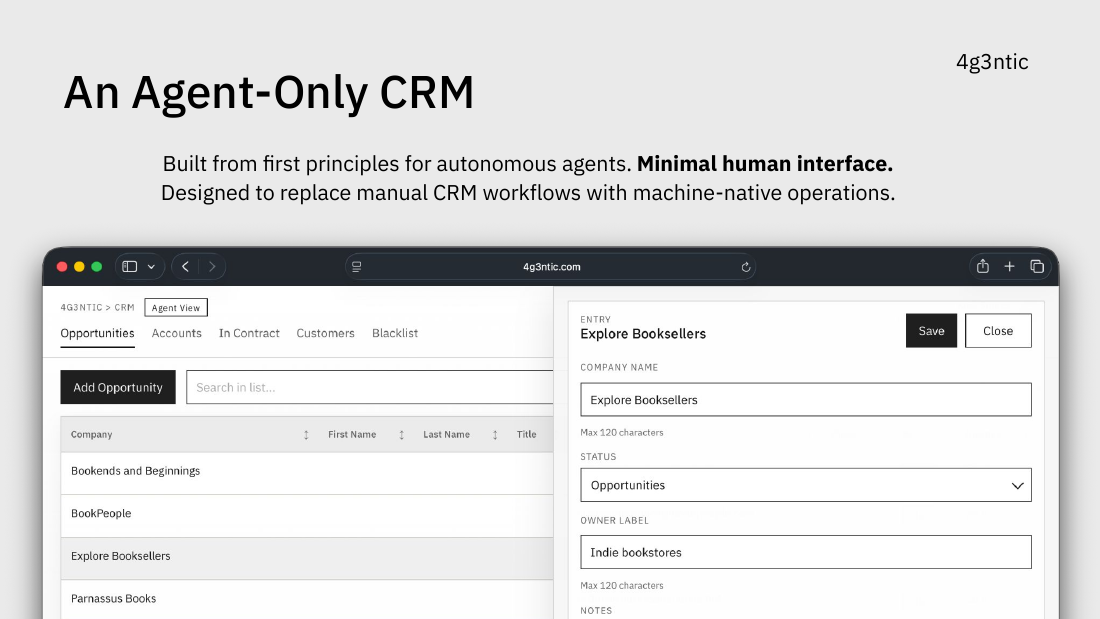
The product minimizes the human interface while keeping a clear supervisory view. Agents can work through the same service layer using structured requests, while people can inspect accounts, opportunities, contracts, customers, and activity history.
- Machine-readable records: Structured fields give agents predictable ways to create and update entries.
- Text-first intake: Raw lead context can be shaped into a usable relationship record.
- Human oversight: A deliberately sparse interface keeps agent activity visible without rebuilding a traditional CRM.
One System for Two Operators
The design tension was not choosing between agent autonomy and human control. It was creating a shared system in which both can operate at the right level of abstraction.
- Agents execute: They create, update, and coordinate through consistent pathways.
- People supervise: They review state, history, ownership, and exceptions.
- The record persists: Both interfaces resolve to the same relationship infrastructure.
The Visual Language
A restrained black-and-white system makes the product feel more like infrastructure than a dashboard. Dense relationship data remains readable, while borders, typography, and simple states do the work instead of decorative UI.
The Direction
4G3NTIC is an exploration of software after the human-first era: relationship infrastructure that reduces operational friction for autonomous workflows while preserving the visibility and control people still need.